

How does your KiwiSaver balance compare?
It’s a question many have wondered at some point. Is my KiwiSaver balance good enough for my age? Am I behind? Ahead?
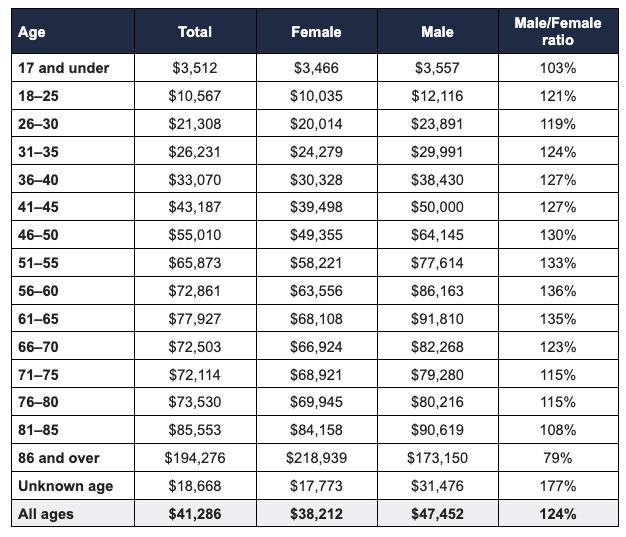
Te Ara Ahunga Ora, the Retirement Commission, recently released a full breakdown of average KiwiSaver balances by age and gender, as at the end of 2025.(1)
Useful information, but like most averages, it can be easy to read the wrong way.
So let’s unpack what it means.
KiwiSaver average balances at a glance
Source: Melville Jessup Weaver, KiwiSaver Demographic Study, March 2026, prepared for Te Ara Ahunga Ora Retirement Commission.
The average KiwiSaver balance across all members is now $41,286, up 11.3% on last year. The report doesn’t tell us how much of that increase is due to contributions versus investment growth.
What’s more interesting is that the average balance for men is $47,452, compared with $38,212 for women.
This 24% gap isn’t evenly spread. It widens through people’s working years, likely reflecting a mix of factors: the gender pay gap (sitting at 5.2% as at June 2025(2)), more time out of paid work for caregiving(3), and a higher likelihood of part-time work among women during those years(4).
But besides these patterns, how much should any of this matter to you?
Why comparing yourself to “the average” can be misleading
Here’s the thing about averages: they’re pulled around by the numbers at the extremes.
A relatively small group of members with much larger or smaller balances can drag the overall figure well away from what’s actually typical for people your age.
The Retirement Commission’s data(1) proves this point. Roughly a third of KiwiSaver members currently have less than $10,000 in their account. At the other extreme, close to 15% hold more than $80,000. Same average, wildly different realities on either side of it.
What explains the gap?
Contribution history plays a big part. The report’s own numbers back this up: members who’ve been contributing regularly have an average balance of $50,727, compared with just $19,553 for those who haven’t.
But contribution history doesn’t look the same for everyone. Self-employment, a career break, parental leave, part-time hours, study or simply starting later in life – all of it has an impact.
What matters is your own trajectory
Your KiwiSaver balance isn’t a scoreboard against a stranger’s. How it’s tracking toward your retirement goals is what actually counts.
Here are some steps you can take to stay on track.
- Work out what you’re aiming for
You can’t know if you’re on track until you know what “on track” means for you. NZ Super alone rarely covers a comfortable retirement(5) – the gap between what it pays and what most retirees spend can run into hundreds of dollars a week. The goal is to find ways to bridge that gap.
Two of our earlier articles can help you put a real number on it: what retirement might cost you, and how much you’ll need to save to get there.
- Take stock of the investments you already have
Once you know the target, look at what’s working toward it: your KiwiSaver and any other savings or investments sitting alongside it. Are they still appropriate?
- Adjust what you can control
From there, it’s about the levers you can pull: your KiwiSaver contribution rate, your fund type, how diversified your investment portfolio is, and more. It doesn’t even need to be a big overhaul. Small changes can have a significant impact in the long run.
- Catch up after a break
If you’ve had time out of paid work, it’s worth revisiting your contributions once you’re back earning. You might have lost a bit of momentum, but that doesn’t mean you’ve fallen permanently behind. Even bumping your contribution rate up or making a lump-sum catch-up contribution where affordable can help rebuild momentum over time.
- Keep reviewing your strategy
A lot can change in a year. Revisiting your KiwiSaver settings gives you a chance to ensure that your investments keep up with your life.
Want a second set of eyes on it?
Averages are a useful backdrop. But they can’t tell you what your retirement should look like, or whether your current strategy will get you there.
If you’d like some help running your numbers and understanding your options, get in touch with an Invest Link adviser.
Sources:
1) Te Ara Ahunga Ora Retirement Commission / Melville Jessup Weaver – KiwiSaver Demographic Study, March 2026 (data as at 31 December 2025)
2) Stats NZ – Gender pay gap narrows to lowest on record (27 August 2025)
3) Ministry for Women, Labour Market Participation, citing Stats NZ HLFS data (June 2025):
- 35.0% of all working women are mothers, and 81.9% of sole parents are women
- Women’s labour force participation rate was 66.5%, compared with 74.7% for men
4) Stats NZ labour market spokesperson Abby Johnston (March 2025): Approximately 21 percent of employed people work part-time – 12 percent of men and 30 percent of women.
5) Massey University & NZ Fin-Ed Centre – New Zealand Retirement Expenditure Guidelines 2025 (October 2025)
Disclaimer: The information provided in this article is intended for general informational purposes only and does not constitute financial advice. Every individual’s financial situation is unique, and financial decisions should be made based on your specific circumstances and goals. We recommend consulting with a qualified financial adviser before making any investment, insurance, or mortgage-related decisions.
Please visit important-information-about-us-invest-link.pdf for more and disclosure information

